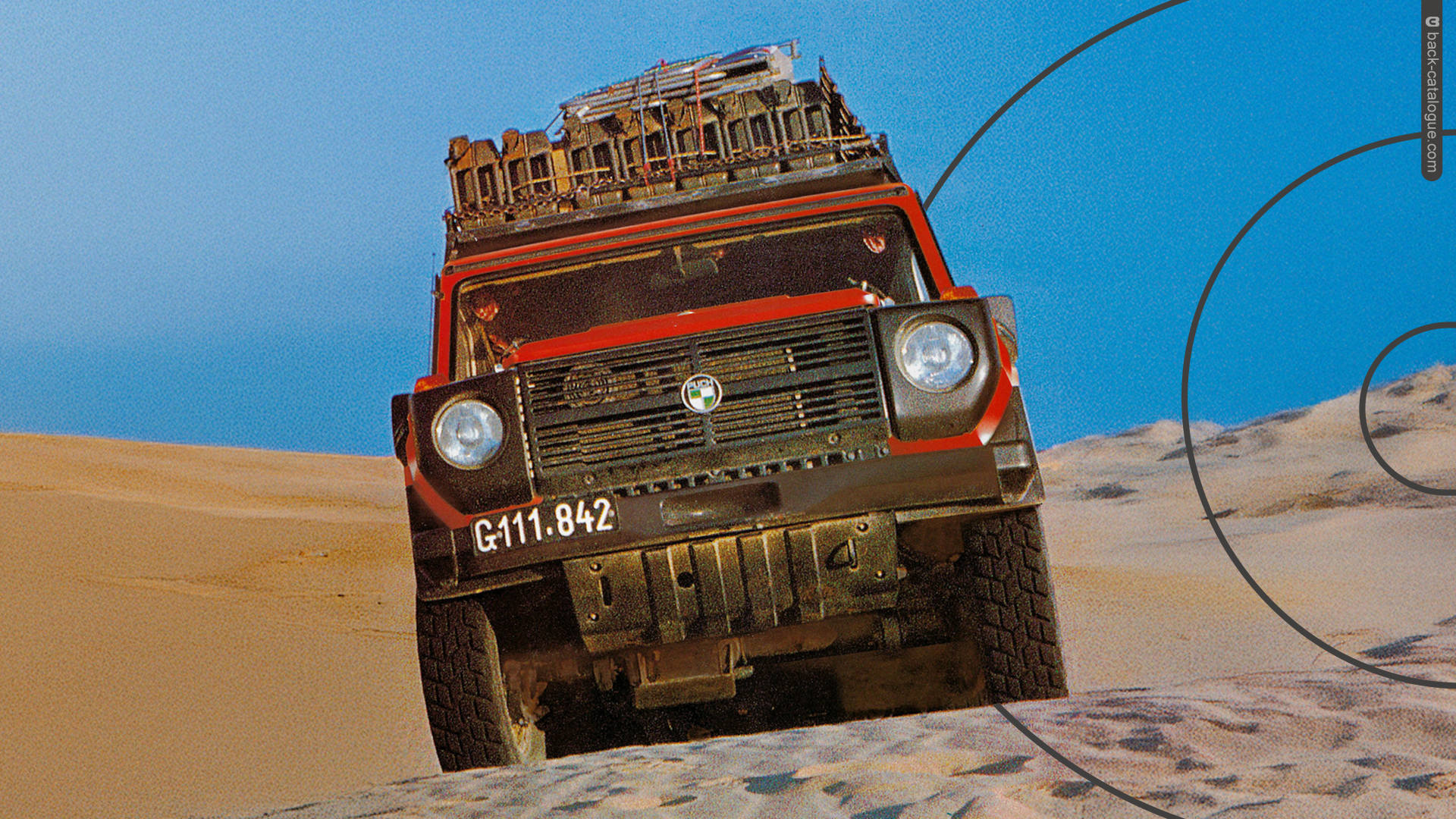
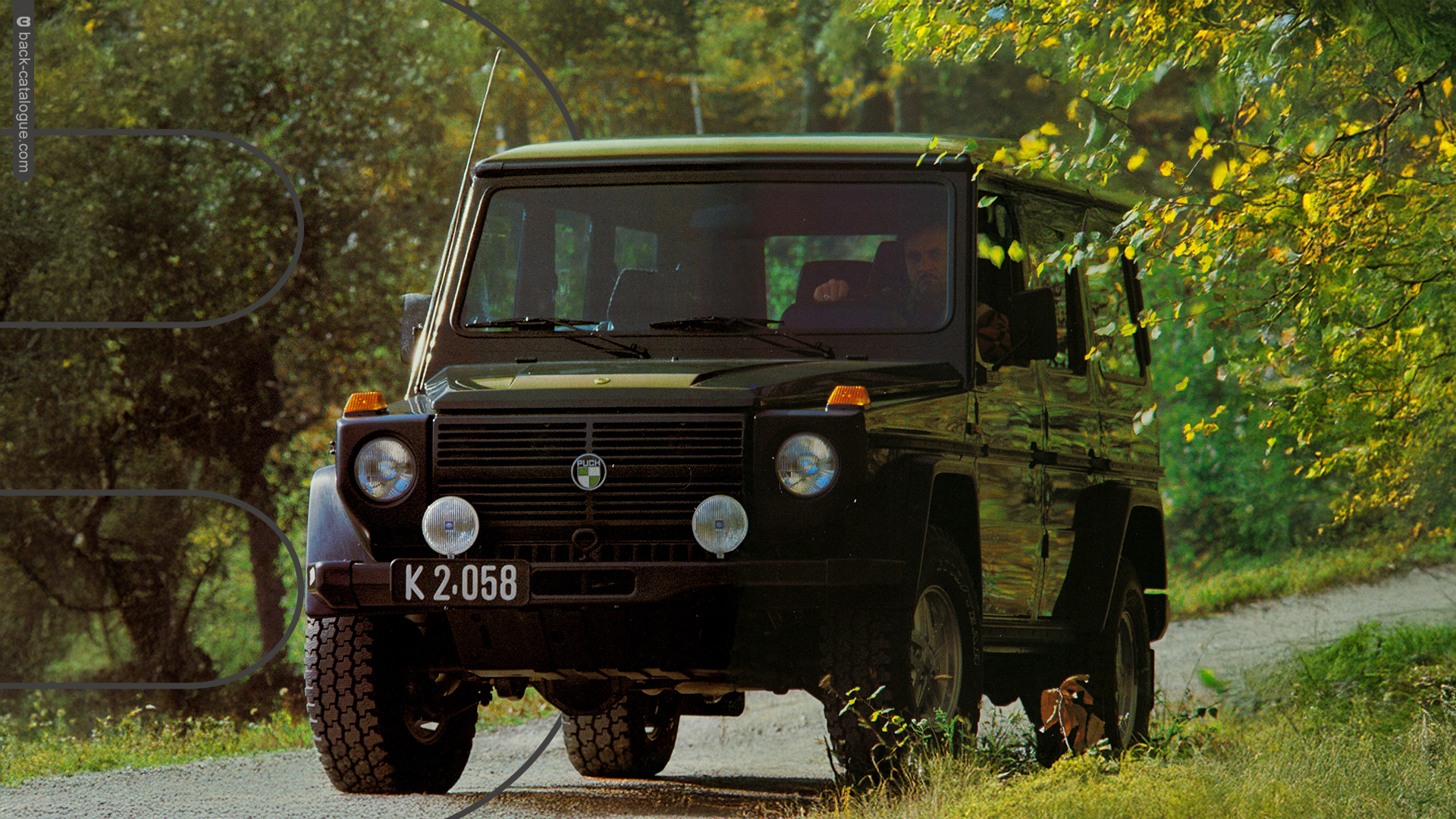
Suitable for Off-Road (or Cross-Country). Steyr-Daimler-Puch has been building off-road vehicles for decades.
The small, light Haflinger was the first in the successful series of off-road vehicles. It was later replaced by the larger, more powerful Pinzgauer. Today, they are in use all over the world. And they are among the few vehicles that can manage even the most difficult terrain, nimbly and quickly, even without chains.
After so much experience and so much success in the field of off-road vehicle construction, the development of a comfortable passenger car (PKW) version was the next logical step.
A cross-country sedan (off-road limousine) emerged from the collaboration between Steyr-Daimler-Puch and Daimler-Benz, which, regarding driving comfort and extreme durability, meets the well-known Mercedes quality standard. However, when it comes to agility and maneuverability in difficult terrain, it is in no way inferior to the globally recognized Steyr-Daimler-Puch all-wheel-drive vehicles.
Engine Displacement (cm³)
Power (kW)
Top Speed (km/h)
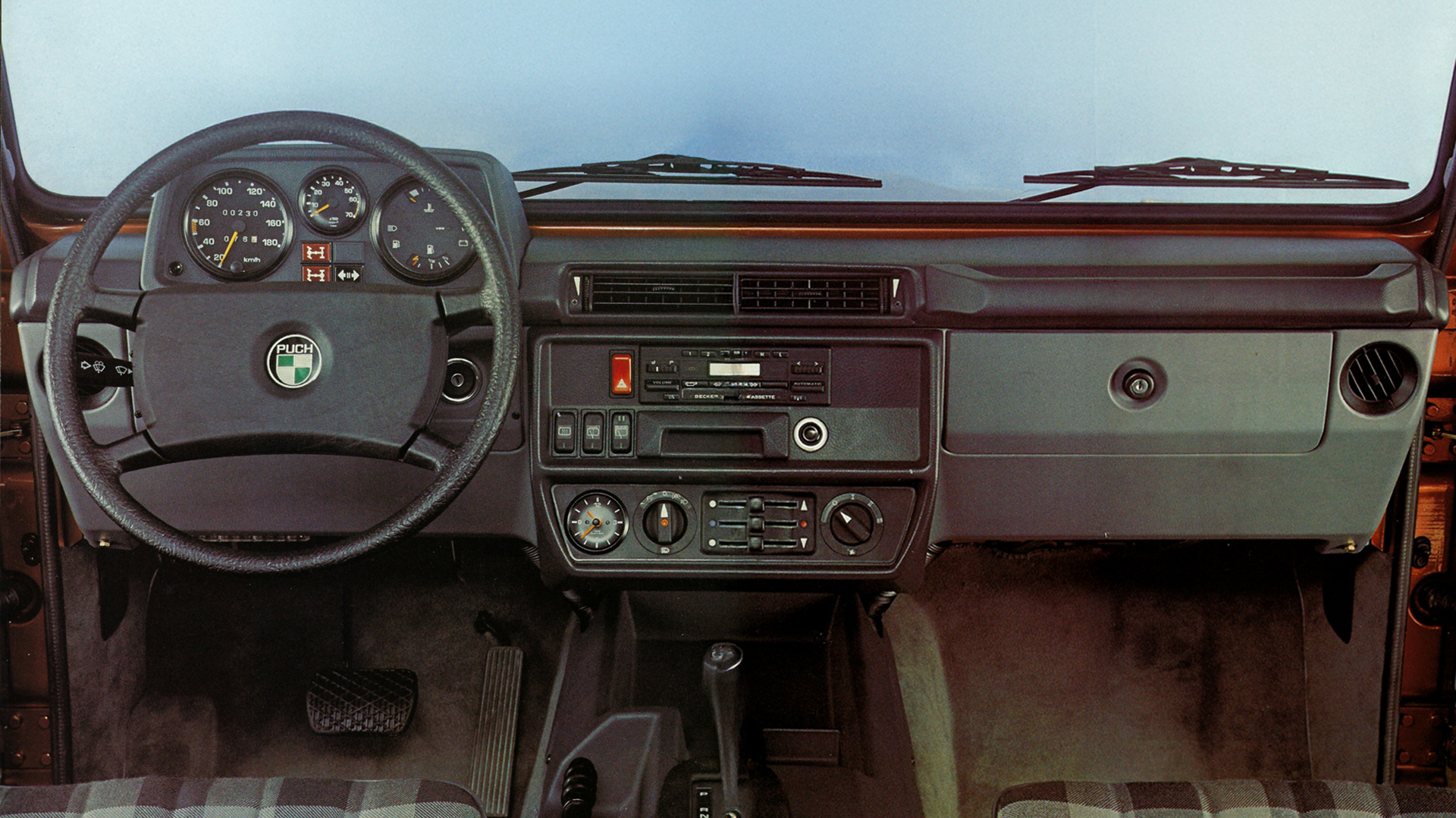
Step in, take a seat, and you immediately have the feeling: this is your car. You have already driven here before.
The seats and instruments are designed and arranged with ergonomic considerations in mind. The gear lever and handbrake are easy and safe to reach. The dashboard provides you with all important information at a glance. And the traffic around you can be surveyed wonderfully. Because you are sitting above it all.
Walk around the Puch G once. What impression does it make on you? Robust, stable, safe. The passenger compartment is built as a rollover-proof safety cell. Deformable crumple zones convert any potential impact into material deformation. The doors absorb laterally acting forces without endangering the interior. The safety steering column collapses upon impact. Three-point automatic seat belts and headrests can be taken for granted. The same goes for the hydraulic dual-circuit brake with automatic brake adjustment. And because you sit higher than in a passenger car, you can react to critical traffic situations earlier and faster.
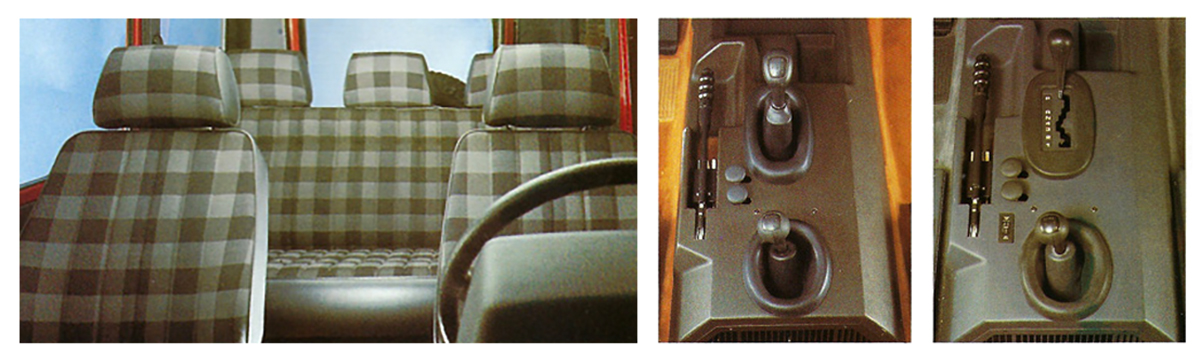
The Seats. The seats in the Puch G are excellently padded and offer very good lateral support. They can be easily adjusted in the longitudinal direction and for backrest inclination. The driver's seat even allows for seat cushion angle adjustment. Sufficient headroom should not need to be specially mentioned in a car of this class. With the Puch G, this is even true for passengers seated in the rear.
All-Wheel Drive and Low-Range Gearing. Time for a test drive. Off the road, onto the wet meadow. A light push of the lever—the front-wheel drive is engaged, without stopping, without clutching, of course. It gets even steeper; we are entering extreme terrain. Another light push of the lever—the low-range gearing (or auxiliary transmission) engages. Also without stopping, conveniently from the cockpit. With the low-range gearing, another 5 or 6 gears are available, which halve the speed while doubling the power to the wheels. The Puch G spoils you in difficult terrain with sophisticated technology that is nevertheless very simple to use. And for those who want even more comfort, they can have an automatic transmission installed, freeing their mind for things more important than shifting gears.
The Differential Locks. And now it gets truly extreme. The front-wheel drive is engaged, and so is the low-range gearing. Suddenly, the right front wheel spins. No problem. A pull of a lever, and the 100% front differential lock springs into action. A control light on the dashboard illuminates, and off we go merrily again, without stopping, over rough terrain, snow, and ice. Of course, a rear wheel may also be stuck; the rear differential lock will then handle that.
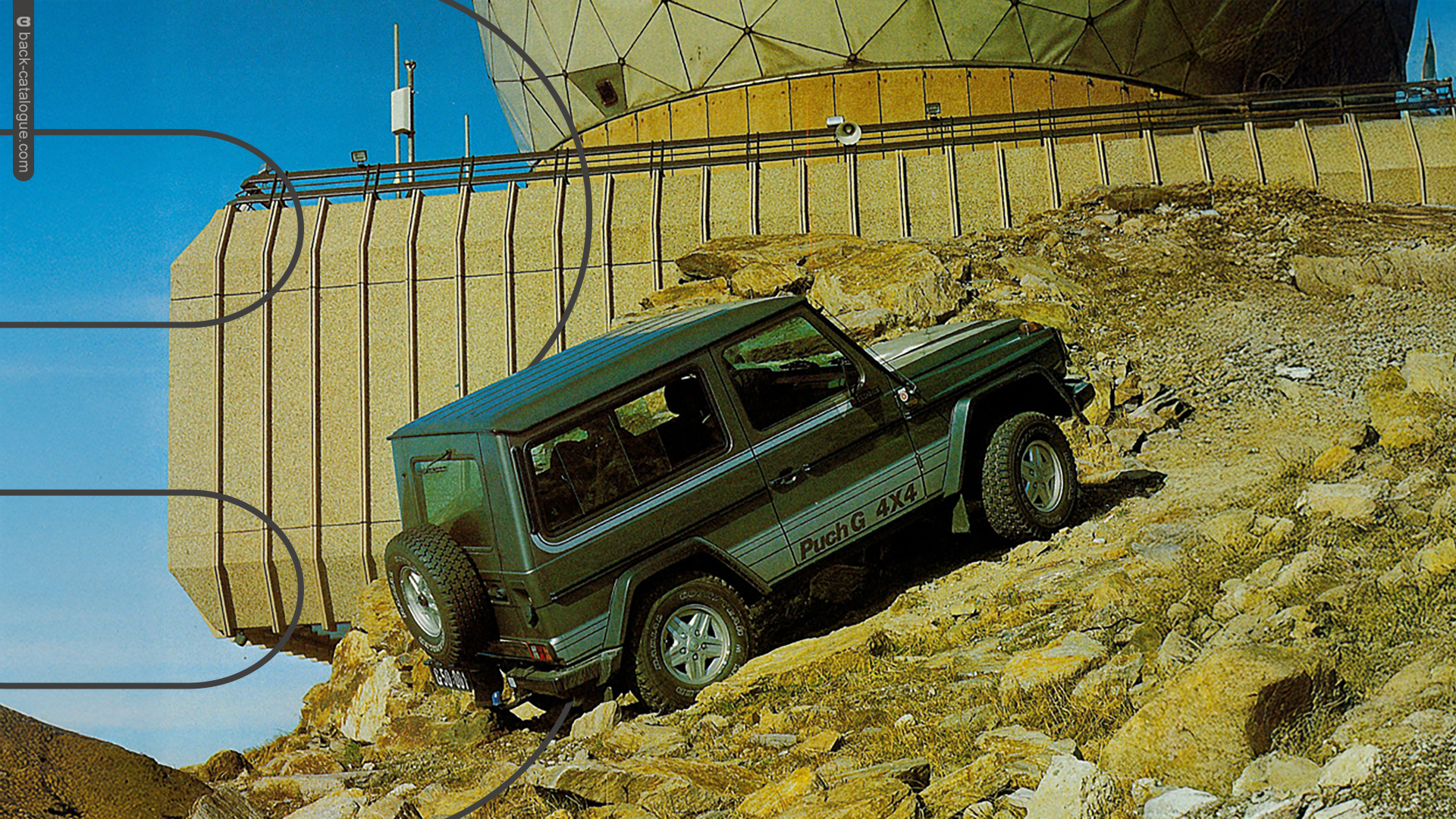
One can expect an off-road vehicle to conquer inclines that other cars have to stop before. While one might not expect the Puch G to conquer inclines that other off-road vehicles have to give up on, that is a fact.
The Puch G overcomes inclines of 80% with ease. Depending on the surface and engine type, it even fights its way over gradients of up to 110%.
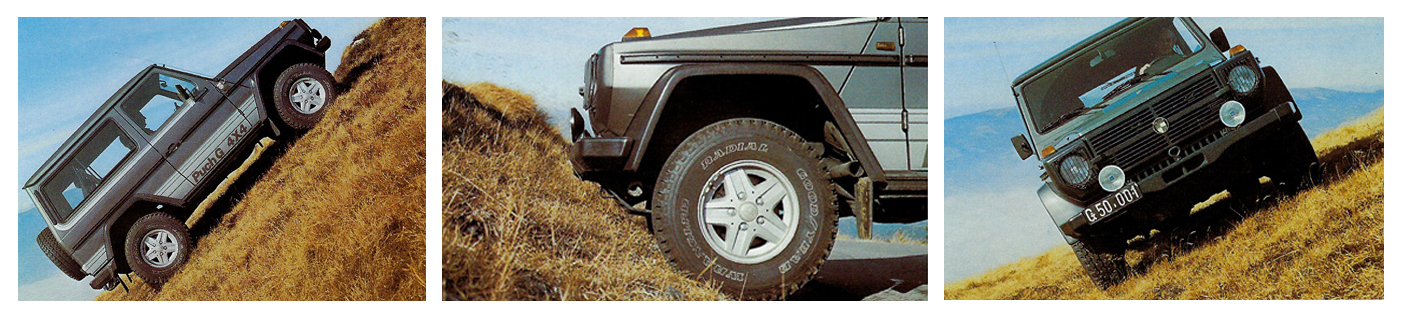
With a car that you enjoy, the impression it makes on your family, friends, or acquaintances shouldn't matter. However, you will have to get used to an appreciative whistle or an admiring "Ooh." Reactions of this kind are completely commonplace with the Puch G.
Over 80% Gradeability. Perhaps you are now thinking that this is impossible. Well, 80% or 110% gradeability means, in plain terms, 80% or 110% of a 45˚ angle. For comparison, your passenger car achieves at most 20% gradeability, and that is only on an asphalt road and not, like the Puch G, in the most difficult terrain.
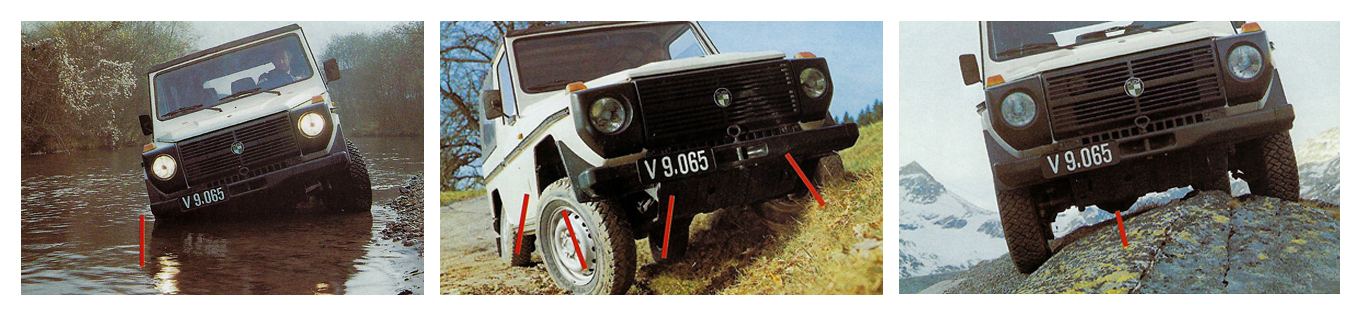
45˚ Approach Angle, 40˚ Departure Angle. The front and rear overhangs on the Puch G are measured very short. The bodywork starts above axle level both front and rear. Thus, the body is never in the way and can never bottom out. This is why slopes with an angle of 40˚ are not a problem for the rear section; for the front section, angles of up to 45˚ are even permissible.
50% Side Slope Angle. From a certain side slope angle, every vehicle tips over. This usually happens when the vehicle gets stuck in such a critical situation. With a Puch G, this won't happen to you so quickly. Due to an optimal vehicle center of gravity and the correct axle load distribution, the Puch G will slide sideways in such a case.
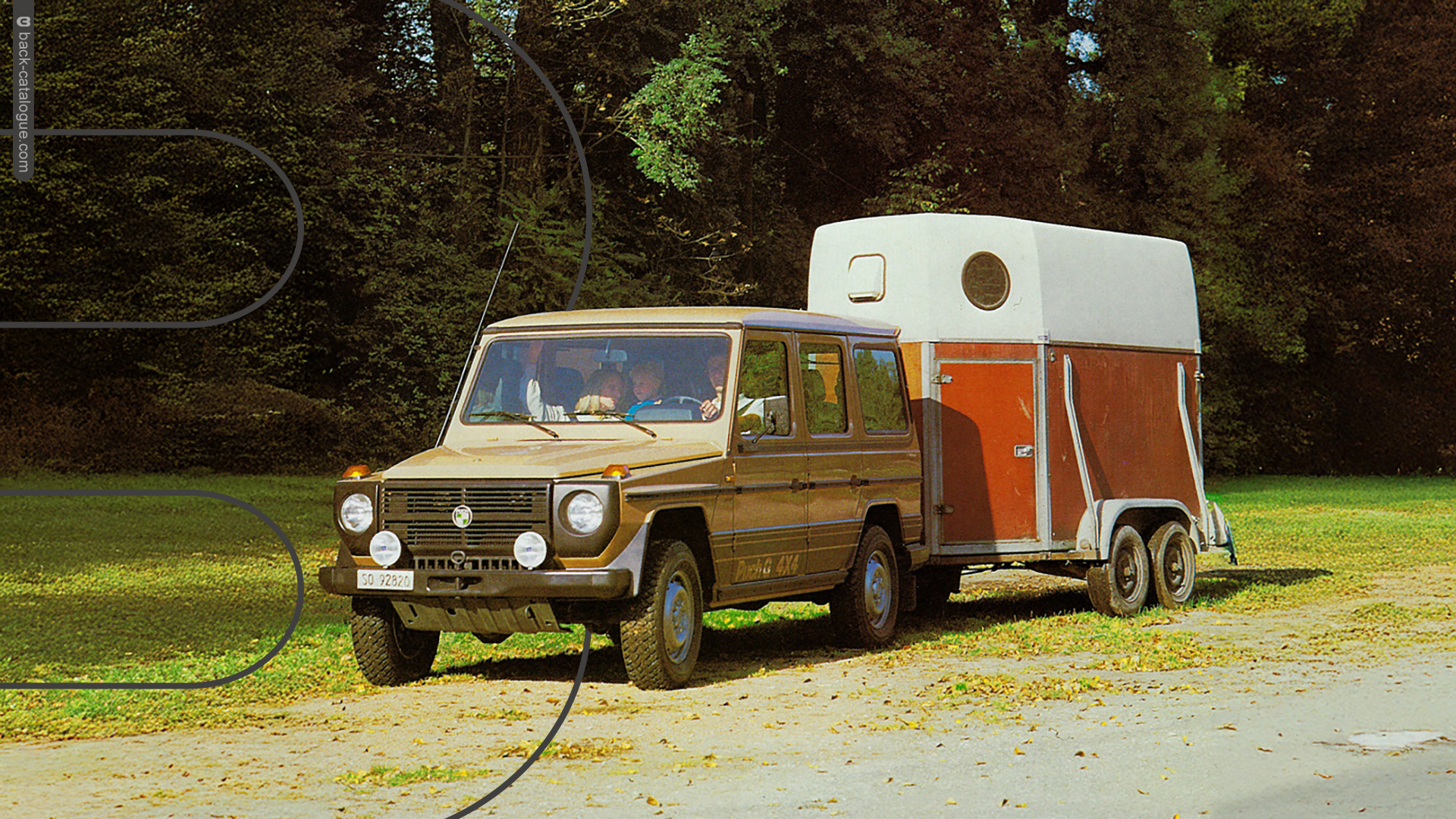
One can expect an off-road vehicle to conquer incThe Puch G proves that good off-road vehicles can also be good touring sedans. The already proverbial Mercedes driving comfort also distinguishes the Puch G. Even if you are on your way to the racetrack with your riding horse or to the Riviera with your sailing yacht, the Puch G leaves nothing to be desired in terms of driving stability, cornering, and straight-line running. The luggage can be easily stowed away, and your family has wonderfully ample space.
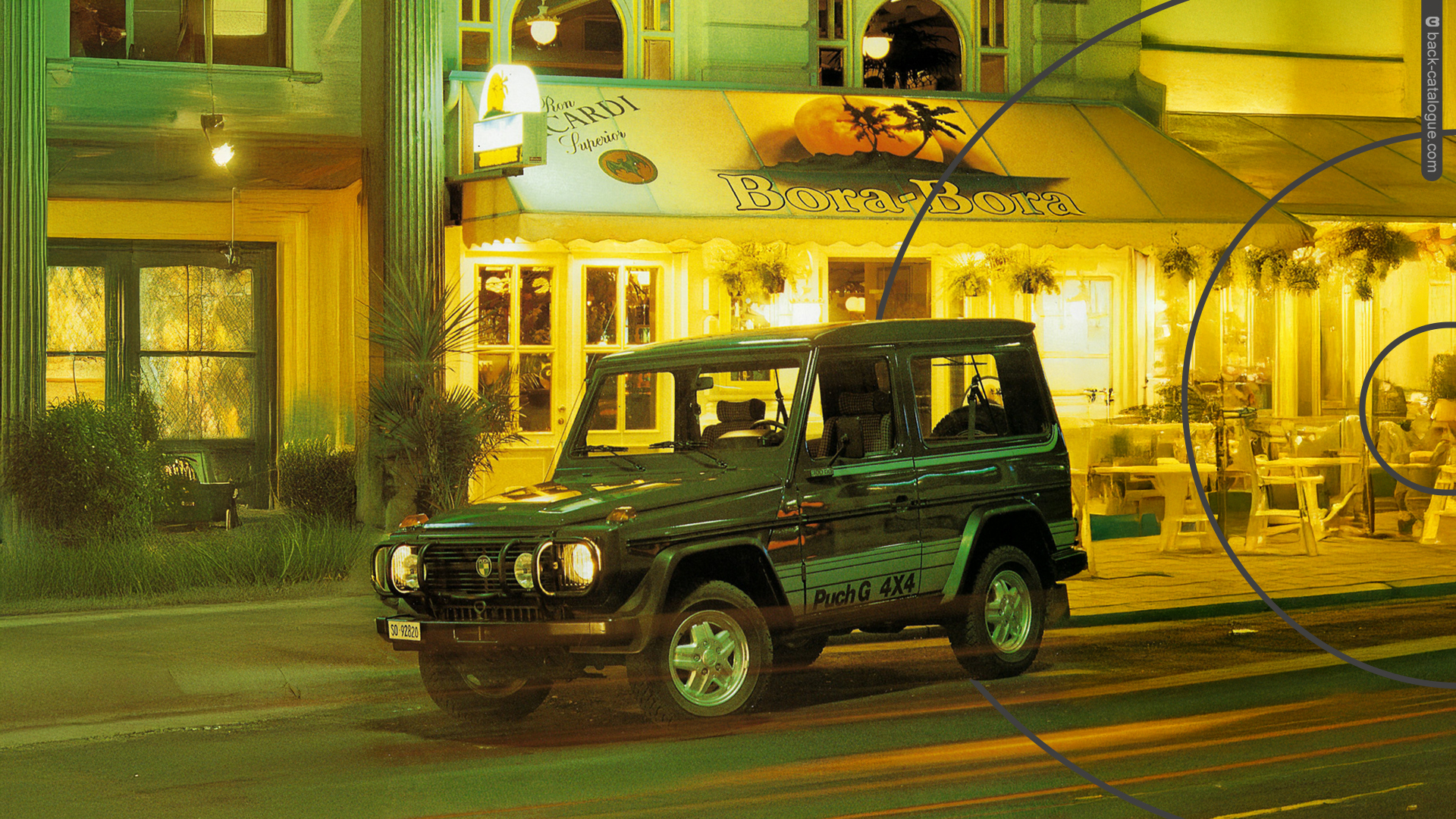
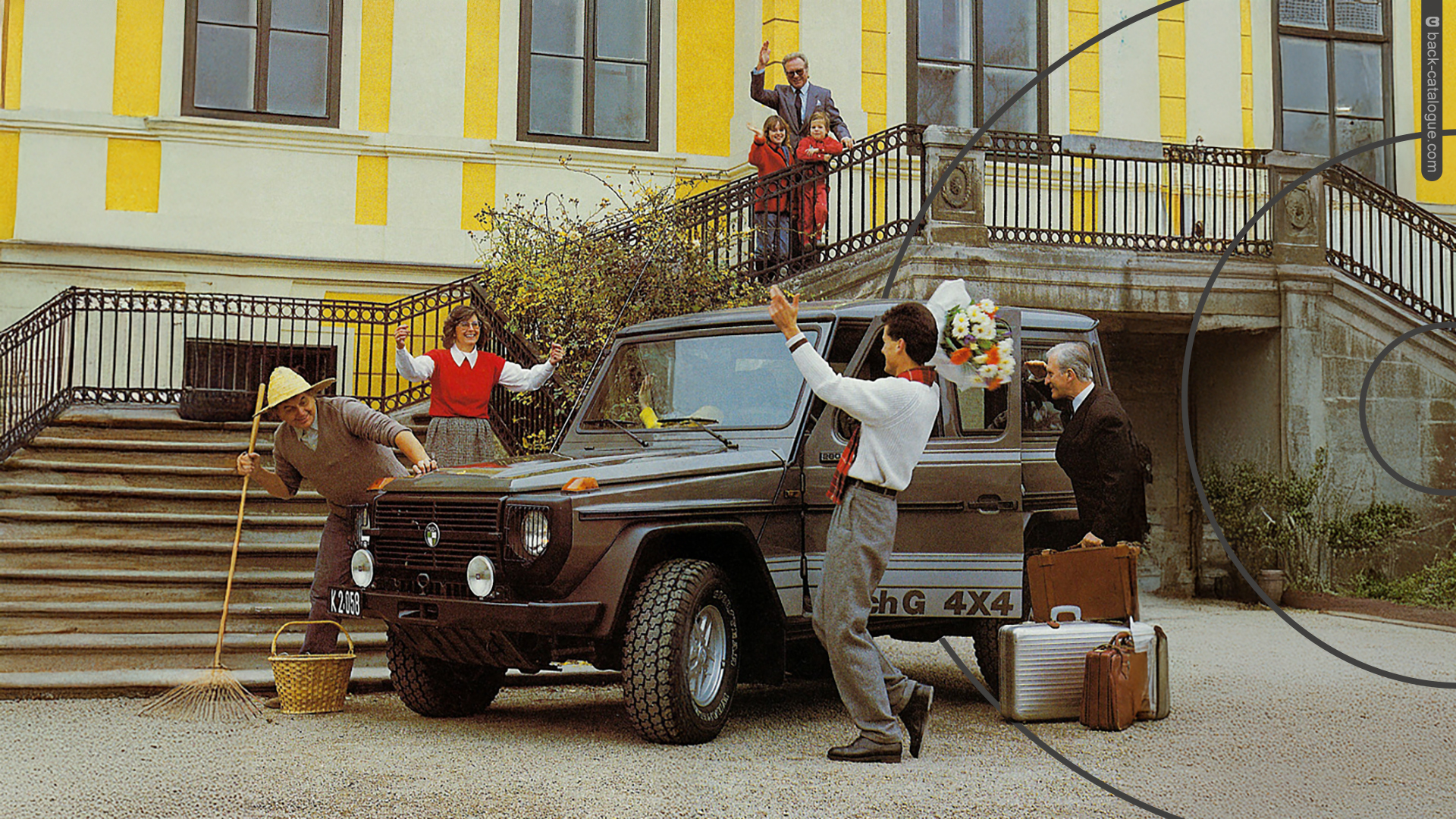
And when the Puch G returns from its off-road deployment to "civilization," it likes to be admired. On the elegant boulevard or in front of the French restaurant. It has even been spotted in front of opera houses and concert halls.

For the Puch G, there are virtually no limits. It takes you wherever you want to go. To the inaccessible spot by the lake where the char are biting best, to the inaccessible spot on the mountain pass where you can find the most untouched deep snow, and to the inaccessible mountain farm that occasionally needs help.The Puch G clears obstacles out of your way and forges a path for you where allegedly none exists. At the same time, it spoils you with sophisticated technology that is very simple to operate.The Puch G is like a friend. You can rely on it 100%.

And in the evenings, you only see it in the best company.
60cm Fording Depth. Dives up to 60cm deep are pure pleasure for the Puch G. After all, why have such refinements as all-wheel drive, low-range gears, and differential locks? It is practically a given that the doors close watertight and that all folds and flanges are sealed against penetrating water, just like the engine and electrical system.
Axle Articulation. A true off-road professional prefers to take one detour too many. But there are situations where you cannot avoid severe unevenness. This is where the performance of the axle articulation shows itself.In the Puch G, the particularly long coil springs allow for large spring travel. As a result, good driving stability is maintained even with large differences in height between the wheels, and passengers are protected from excessively hard jolts. Expressed in numbers, the axle articulation of the Puch G achieves the extraordinary value of 260mm
Ground Clearance. What good is the deepest fording depth and the most beautiful differential lock if the ground clearance isn't right? That's why the Puch G boasts a whole 215mm of ground clearance.
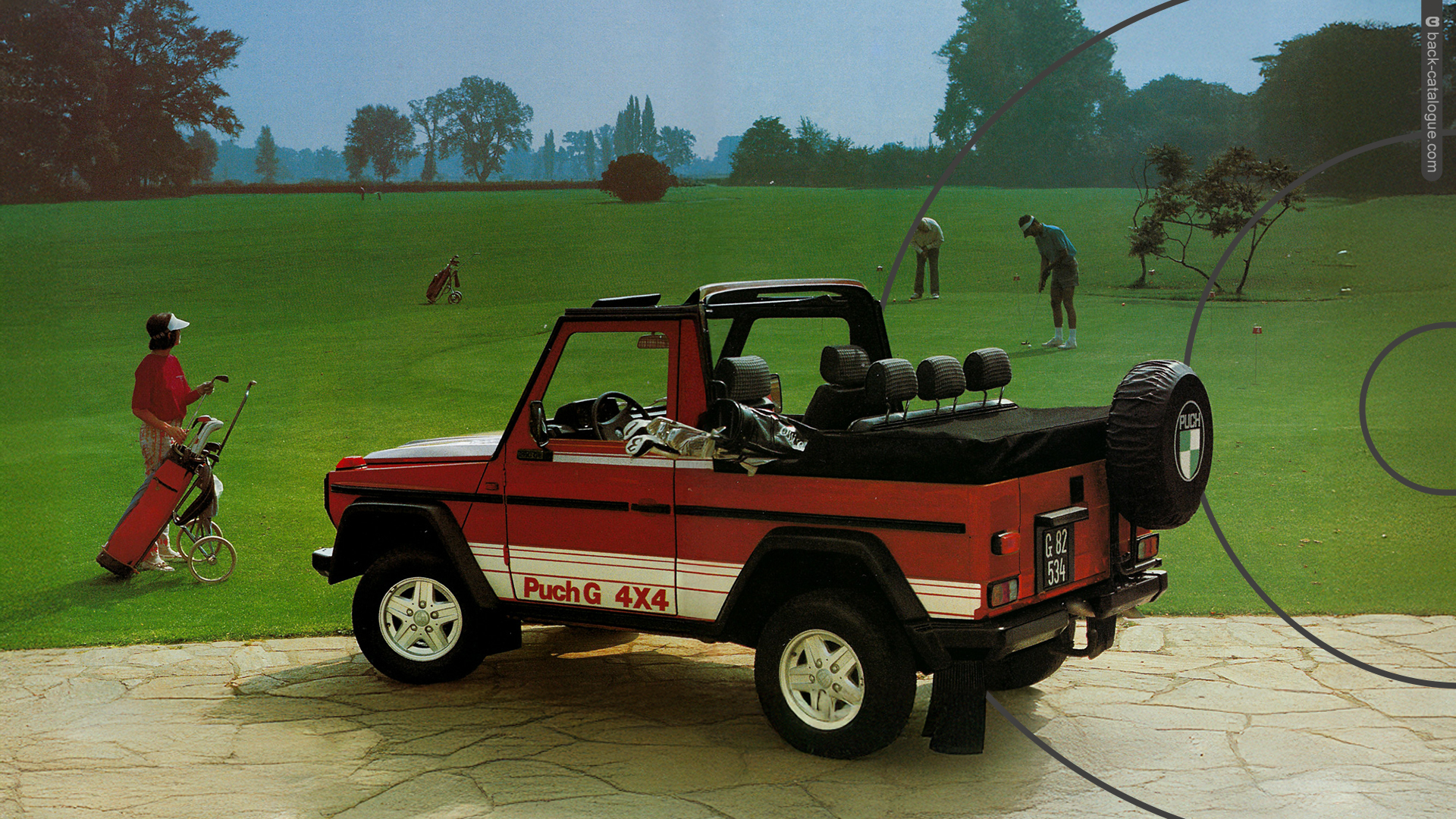
Weekend and sunshine. You leave the stream of traffic behind. You know your way. You know what you want. The wind plays in your hair, the sun tans your face. You are driving a Puch G Cabriolet. It promises to be a beautiful day.
Perfect weather. Down with the folding top. Put it behind the rear seat bench. It doesn't take up any space there. The luggage can still be easily unloaded and loaded through the tailgate. If you would like to drive a Targa for a change, that's also no problem. The Puch G Cabriolet offers you a wide variety of folding variations. Depending on your mood, the wind, and the weather. The operation is very simple.
The Engine. 2.3 L Gasoline Injector with 4 cylinders and 92 kW (125 hp) at 5000 rpm. OR 2.8 L Gasoline Injection Engine with 6 cylinders and 115 kW (156 hp) at 5250 rpm. OR 2.4 L Pre-chamber Diesel Engine with 4 cylinders and 53 kW (72 hp) at 4400 rpm. OR 3.0 L Pre-chamber Diesel Engine with 5 cylinders and 65 kW (88 hp) at 4400 rpm.
The Clutch. Single-plate dry clutch.
The Transmission. Four- or five-speed synchronized gearbox with central shift lever. High-range (road) and low-range (off-road) gears are synchronized.The PUCH 2-shaft transfer case is synchronized and has low-range gearing (approx 2.14).The front-wheel drive can be engaged and disengaged while driving, without clutching and without stopping.Optional Extras: 4-speed automatic transmission with central selector lever. Manually shiftable (except 240 GD), positive-locking differential lock for front and/or rear.
Front and Rear Axle. One rigid axle each, guided by 2 longitudinal and 1 transverse link (Panhard rod).
The Brakes. Service Brake: Hydraulic dual-circuit brake with vacuum booster, discs at the front, duo-servo drum brakes at the rear with automatic adjustment, automatically controlled at the rear depending on load. Parking Brake: Lever handbrake that acts on the rear wheels via a cable.
The Suspension. 2 coil springs on both the front and rear axles. Rubber auxiliary springs serve as additional springs and bump stops both front and rear. Twin-tube telescopic shock absorbers on the front and rear axles. Torsion bar stabilizer on the front axle.
Optional Extras: Power steering.
The Bodywork. All-steel bodywork, bolted to the frame via 8 rubber mounts. Front and rear bumpers. 2 doors with short wheelbase, 4 doors with long wheelbase. All doors have wind-up windows. Torsionally rigid passenger compartment, ensuring optimal safety. Side scuff strips. The tailgate is single-piece, hinged on the left, and has a window. Rear mud flaps.
Optional Extras: Two-piece tailgate with window.
The Locks. Doors with fork latch locks, steering lock with starter repetition lockout, master key for steering lock, doors, and fuel cap. Secondary key for the glove compartment. Rear side doors and single-leaf tailgate with child safety lock.
The Windows. Windshield made of laminated safety glass, side and rear windows made of single-pane safety glass. Electric window washer pump and 3-stage windshield wiper.
Optional Extras: Heated rear window, heat-insulating glass for front and side windows, rear window wiper with washer system. Sliding rear side windows on short station wagon model.
The Seats. Driver's and passenger seat with safety headrests, adjustable in the longitudinal direction and for backrest inclination. Driver's seat additionally equipped with seat cushion angle adjustment (passenger seat optional). 1 grab handle on the roof frame for the passenger. Foldable rear seat bench, in short-wheelbase vehicles in combination with front seats that pivot forward. 2 grab handles above the rear seat bench on the roof frame. Three-point safety belts with automatic retractors for front and rear. An additional lap belt is provided for the rear middle seat.
Optional Extras: Headrests on the rear seat bench.
Heating and Ventilation. Draft-free continuous airflow for hot and cold air with a three-stage fan for the windshield and footwell, 2 adjustable nozzles on the outside of the dashboard, separately controllable for top and bottom. Direct ventilation in the center of the dashboard, pivotable laterally, upwards, and downwards.
Optional Extras: Auxiliary heating, air conditioning.
The Signaling System. Steering column combination switch for turn signals, high beams, asymmetric low beams, and headlight flasher. Automatic reset for turn signals. Horn in the steering wheel. Hazard warning system.
Cargo Area Variations. Open Off-road Vehicle (or Cabriolet), Station Wagon. Wheelbase 2400 mm.Panel Van Wheelbase 2850 mm. Station Wagon Wheelbase 2850 mm. The rear seat bench can be folded down and then stood up (or flipped forward), so that more room for cargo is available. Access to the rear, longitudinally arranged seats is via the single-leaf (two-leaf optional) tailgate.
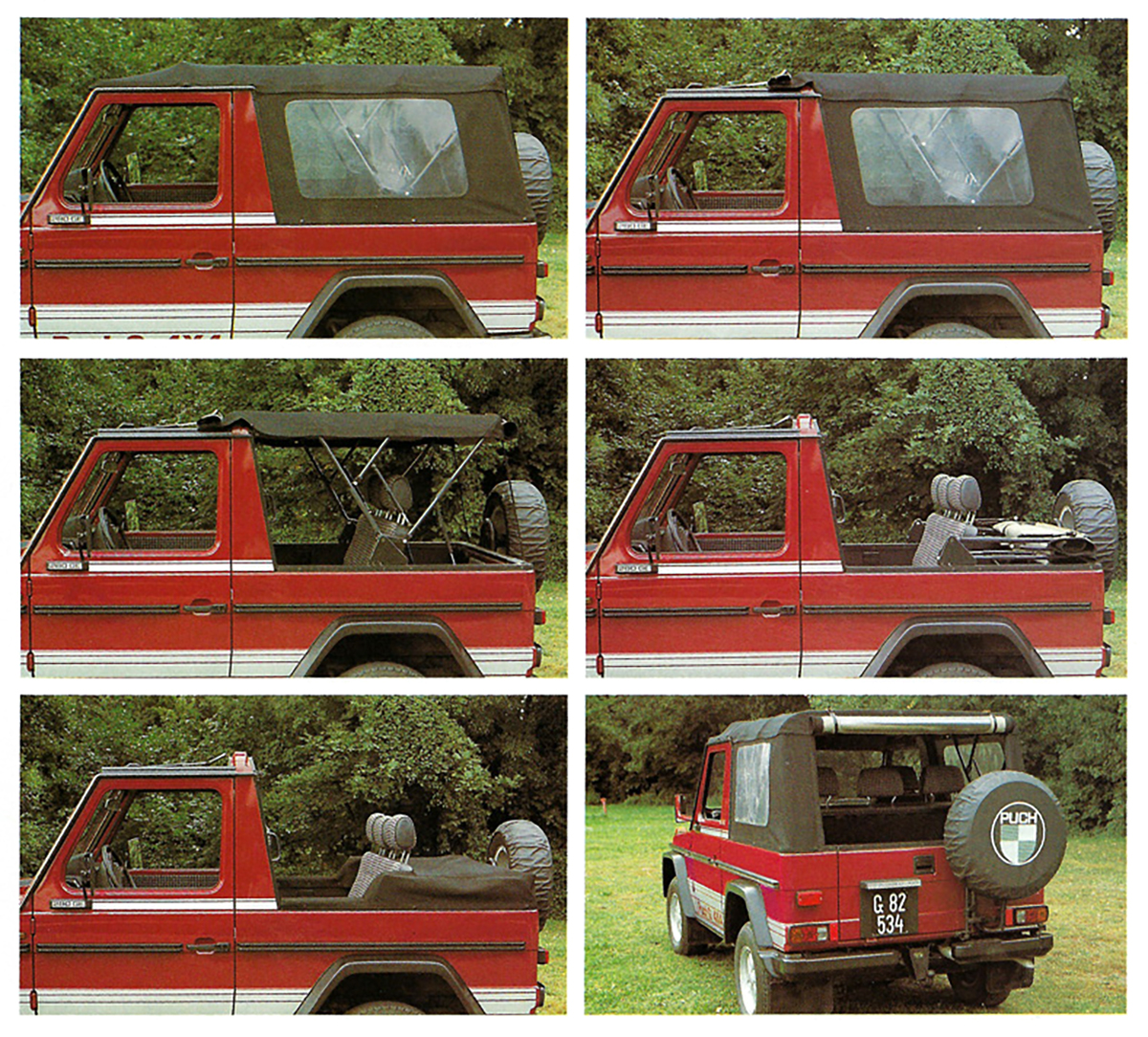
We present the versatile folding variations of the soft top here. Please read the individual steps in the owner's manual of the Puch G Cabriolet before the first drive.
Your Puch G Cabriolet as a Targa. The soft top is only opened up to the roll bar. The roof half is rolled up and held in place by the tensioning bar.
To remove the side panels, you must release the press and hook-and-loop fasteners (snaps and velcro) and pull the side panels out of the guide rails. The rear window section is simply rolled up and secured with retaining loops.
Here the entire soft top is folded and collapsed to the rear.
Finally, the cover is pulled over the folded-down soft top and secured with snap fasteners. The soft top and luggage are thus packed dust-tight.
This is what the Puch G Cabriolet looks like from the rear with the rear window section rolled up.
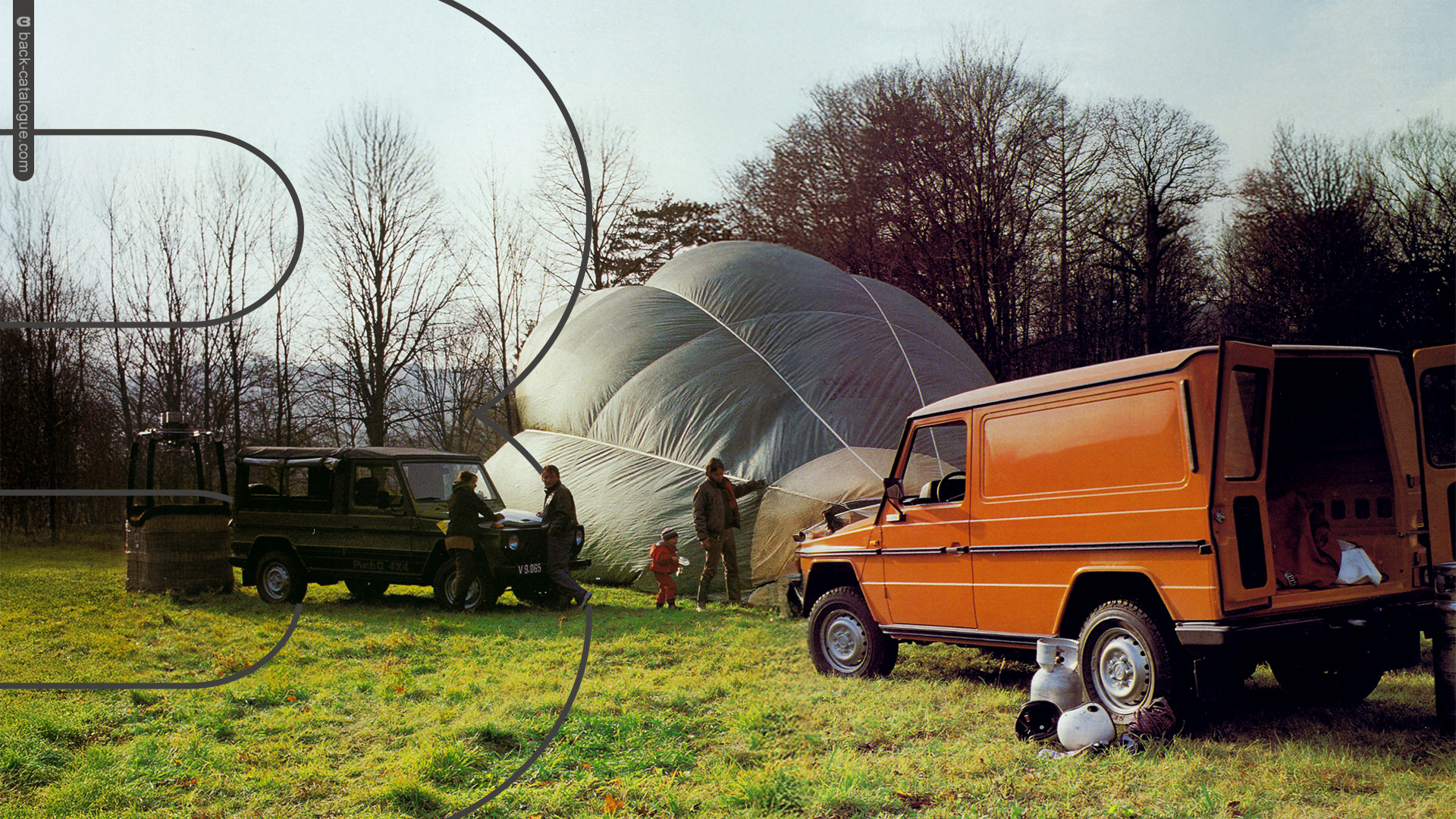
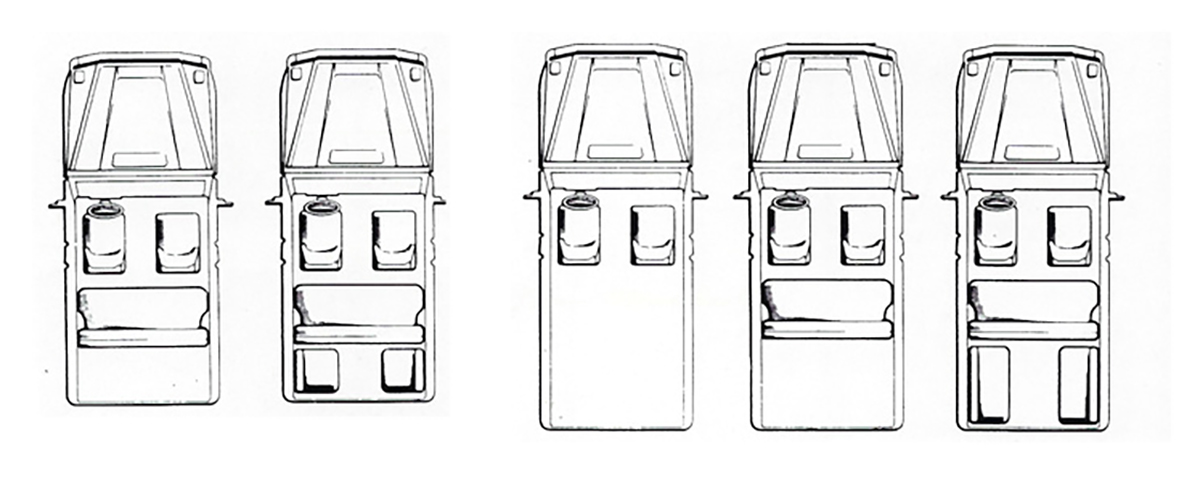
You can choose from a total of 40 variants in the Puch G model range. Once you have decided on one of the 4 basic types, the pleasure begins. You can put together your very own personal Puch G model from 4 engines, 2 wheelbases, 4 different body styles, 4 seating combinations, and 5 paint finishes. For example, a Worker (Panel Van), in which you can finally comfortably fit your champagne cartons. Or the Crew for the balloon launch.
This modular system makes it possible to equip the Puch G very individually according to its planned use. Either for work or for pleasure. Depending on your needs, it gets more cargo space and fewer seats or vice versa, a 4- or 6-cylinder engine, and one or another special feature. Your Puch G model is, so to speak, made to measure. A Panel Van, for example, is configured so that your empty pallets fit just as well as the complete ballooning equipment. But one should also be allowed to demand that from a car of this class.
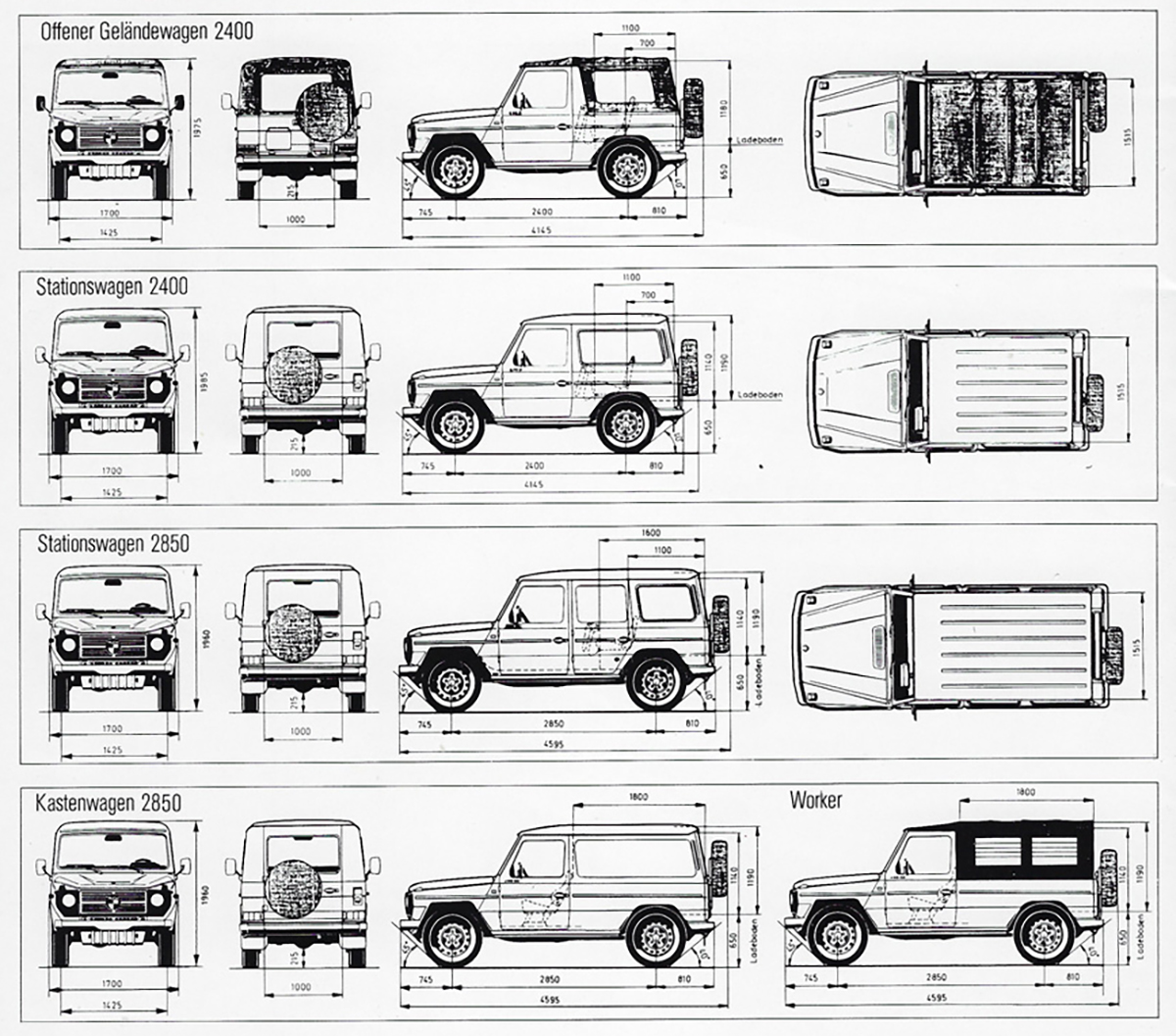
| Open Off-Road Vehicle 2400 | Station Wagon 2400 | Station Wagon 2850 | Van 2850 | |
| Wheelbase | 2,400 mm | 2,400 mm | 2,850 mm | 2,850 mm |
| Track front and rear | 1,425 mm | 1,425 mm | 1,425 mm | 1,425 mm |
| Length (without spare wheel) | 3,945 mm | 3,945 mm | 4,395 mm | 4,395 mm |
| Width (without exterior mirror) | 1,700 mm | 1,700 mm | 1,700 mm | 1,700 mm |
| Height (unladen) | 1,975 mm | 1,960 mm | 1,960 mm | 1,960 mm |
| Turning Circle | 11.4 m | 11.4 m | 13.3 m | 13.3 m |
| Curb Weight (depending on equipment) | 1,720 - 1,740 kg | 1,800 - 1,870 kg | 1,905 - 1,975 kg | 1,900 kg |
| Permissible Gross Weight | 2,600 kg | 2,600 kg | 2,800 kg | 2,800 kg |
| Ground Clearance | 215 mm | 215 mm | 215 mm | 215 mm |
| Tire Size | 205 R 16 | 205 R 16 | 205 R 16 | 205 R 16 |
| Approach Angle (front) | 45° | 45° | 45° | 45° |
| Departure Angle (rear, without coupling) | 40° | 40° | 40° | 40° |
| Load Compartment (rear seat in operating position) | 765 dm³ | 743 dm³ | 1,340 dm³ | - |
| Load Compartment (rear seat folded down) | 1,740 dm³ | 1,730 dm³ | 2,590 dm³ | 2,650 dm³ |
| Fuel Tank Capacity (Reserve) | 70 l (11 l) | 70 l (11 l) | 70 l (11 l) | 70 l (11 l) |
| 230 GE | 280 GE | |
| Engine | ||
| Engine Type | Four-cylinder with petrol injection M 102 E | Six-cylinder with petrol injection M 110 E |
| Valve Arrangement | Overhead | Overhead |
| Displacement | 2299 cm³ | 2746 cm³ |
| Engine Output | 92 kW / 125 PS at 5000 rpm | 115 kW / 156 PS at 5250 rpm |
| Maximum Engine Speed | 6000 rpm | 6300 rpm |
| Bore / Stroke | 95.5 / 80.25 mm | 86.0 / 78.8 mm |
| Compression Ratio | 9 : 1 | 8 : 1 |
| Maximum Torque | 192 Nm / 19.6 kpm at 4000 rpm | 226 Nm / 23 kpm at 4250 rpm |
| Injection Pump | mech. petrol injection* *with airflow measurement |
mechanical petrol injection* *with airflow measurement |
| Oil Filling in Engine max./min. | 5.5 l max. / 4.0 l min. | 7.5 l max. / 6.0 l min. |
| Cooling | Water circulation, Thermostat | Water circulation, Thermostat |
| Electrical System | ||
| Electrical System | Three-phase Alternator 14 V / 55 A | Three-phase Alternator 14 V / 55 A |
| Battery Capacity | 12 V / 66 Ah | 12 V / 55 Ah |
| Performance | ||
| Top Speed | 143 km/h | 155 km/h |
| 240 GD | 300 GD | |
| Engine | ||
| Engine Type | Four-cylinder Pre-chamber Diesel OM 616 | Five-cylinder Pre-chamber Diesel OM 617 |
| Valve Arrangement | Overhead | Overhead |
| Displacement | 2399 cm³ | 2998 cm³ |
| Engine Output | 53 kW / 72 PS at 4400 rpm | 65 kW / 88 PS at 4400 rpm |
| Maximum Engine Speed | 5300 rpm | 5100 rpm |
| Bore / Stroke | 90.9 / 92.4 mm | 90.9 / 92.4 mm |
| Compression Ratio | 21 : 1 | 21 : 1 |
| Maximum Torque | 137 Nm / 14 kpm at 2400 rpm | 172 Nm / 17.5 kpm at 2400 rpm |
| Injection Pump | Bosch Four-plunger Pump* *with timing device |
Bosch Five-plunger Pump* *with timing device |
| Oil Filling in Engine max./min. | 6.5 l max. / 5.0 l min. | 7.0 l max. / 5.5 l min. |
| Cooling | Water circulation, Thermostat | Water circulation, Thermostat |
| Electrical System | ||
| Electrical System | Three-phase Alternator 14 V / 55 A | Three-phase Alternator 14 V / 55 A |
| Battery Capacity | 12 V / 88 Ah | 12 V / 88 Ah |
| Performance | ||
|---|---|---|
| Top Speed | 120 km/h | 130 km/h |